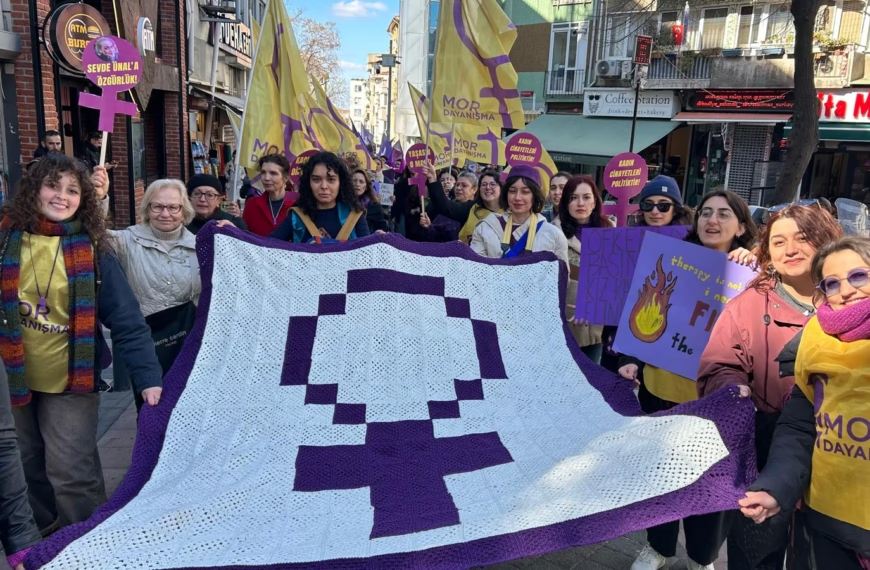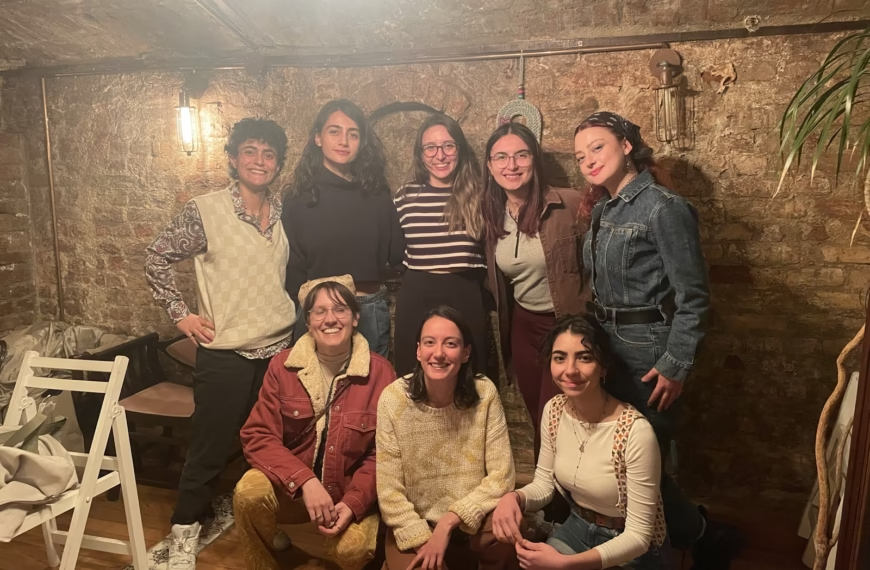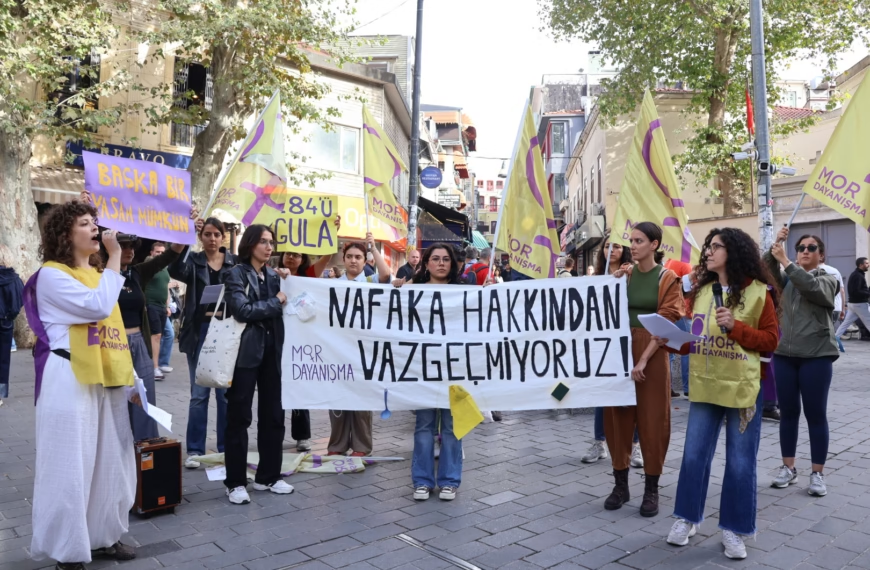

As Mor Dayanışma, on January 14, 2024, we organized an international symposium at Müze Gazhane in Kadıköy, İstanbul, with the participation of women involved in feminist struggles from six different countries. The symposium was built around the sharing of experiences that each participant had developed through struggles in their own country.
The symposium was held in two sessions. In the first session, moderated by İrem Kayıkçı, a member of Mor Dayanışma’s Central Coordination, experiences from Poland, Lebanon, France, Italy, and Iran were discussed.
Journalist Diana Moukalled, the participant from Lebanon, drew attention to the political and economic crisis and poverty experienced in Lebanon since 2009, while also addressing the increasing attacks against women and LGBTQ+ people in 2023. Emphasizing that women’s living standards in Lebanon are better compared to many Arab countries, Moukalled concluded her speech by saying: “Lebanese women’s struggle continues. In Lebanon and across the Middle East, feminist struggle is facing attempts at depoliticization. The state feminism that has emerged in Lebanon and in many other countries turns women into passive victims. Yet, despite all this, many feminists continue to struggle.”
Fatima Babakhani, founder of Mehr Shams Afarid and participant from Iran, began her speech with the slogan “Woman, Life, Freedom” in Persian. Emphasizing the importance of women’s organizing, Babakhani shared the activities they have carried out in Iran, focusing especially on their experience with women’s shelters.Babakhani stressed that women’s struggle reached a new level with Mahsa Amini and said: “There is a strong similarity in the demands of women’s movements across the region. Against inequality, bans, and restrictions imposed on women, we are struggling for equality for all. After Mahsa Amini’s death, women now show the courage to walk in the streets without headscarves, and women in prison appear before the court without headscarves. This is a gain for us. It reflects a victory achieved in the public sphere.”Babakhani concluded her remarks by saying, “Women have changed society and culture.”
Lucia Amorosi, a member of Potere al Popolo from Italy, began her speech by saying, “In our grassroots organizing, we challenge gender.” She spoke about their organizing activities and the demands of their struggle.Stating that “feminism has changed Italy’s political atmosphere,” Amorosi emphasized that they are a socialist and communist organization, and underlined the importance and conditions of overthrowing existing capitalism. She noted that feminist theory sheds light on reproduction under capitalism, women’s unpaid labor, and this economic exploitation, while also emphasizing the importance of feminist politics in the face of the consequences of neoliberalism, as well as the importance of international struggle.
Zuzanna Dorota Karcz, founder of New Wave of Activism and participant from Poland, began her speech by saying that their experiences were different. She described the process through which mobilizations for abortion rights took place in Poland, explaining how the movement developed and emphasizing the importance of their experiences in online activism and activism in the field of education, especially for young women and LGBTQ+ people.
Arya Meroni, a member of Assemblée féministe Montreuil and Coordination Féministe from France, stated that feminism had undergone a renewal with the Me Too movement beginning in 2018. She emphasized that the traditional feminist movement had become insufficient after 2018 and that this process brought certain changes with it.After discussing the position taken by the feminist coordination against rising Islamophobia and anti-migrant sentiment in France, as well as the coordination’s remaining shortcomings and defeats, the session concluded with additional contributions and questions from the audience.
The second session of the Symposium on Experiences of International Feminist Struggle, attended by many artists, began with welcoming speeches addressed to the symposium participants by Perihan Koca, founding member of Mor Dayanışma and DEM Party Mersin MP, and artist Gaye Su Akyol.
In the session moderated by Pelin Songül Çiçek, a member of Mor Dayanışma’s Central Coordination, various experiences from Turkey were shared. The first speaker, Mor Dayanışma Spokesperson Cemile Baklacı, delivered her presentation titled “Experiences of Feminist Local Organizing from Homes to Workshops.”Referring to the rise of fascism in the world and in Turkey, as well as the last ten years of struggle, Baklacı spoke about the history of feminist struggle, saying: “History will not be written through the history of the oppressors, but through the history of those who struggle.” She also addressed the question “What Is to Be Done?”Baklacı drew attention to the need to build a specific relationship with the LGBTQ+ movement, to struggle together against hostility toward migrants, to develop policies against the collapsing family system, to take more serious steps on the basis of alliances, and to build a political and practical line that places women’s needs at the center of the general political agenda. She also emphasized the need for feminist struggle to organize and grow stronger against the rising right, and to strengthen the grounds for international feminist struggle.
DİSK Genel-İş member Ayşecan Ay delivered a presentation on feminist struggle experiences within trade union struggle, sharing the experiences of the Purple List and their gains against trade union bureaucracy.Ay concluded her remarks by saying: “We cannot speak of a united labor struggle when one component exploits the labor of another. Precisely for this reason, feminism and the labor movement must act together. We are not dividing the class; we are the class.”
Adalet Kaya, a member of Tevgera Jinên Azad (TJA) and DEM Party Diyarbakır MP, spoke about the past and present of the Kurdish Women’s Movement. Referring to the historical background of the movement and the experience of being Kurdish, Kaya said: “We found feminism in connection with our question of being Kurdish.”Emphasizing that the government’s recent anti-women policies have been directed particularly against Kurdish women, Kaya concluded her remarks with a demand for peace.
Campus Witches shared their experiences of organizing young women at universities. They drew attention to the fact that young women are at the center of the government’s pressures, as well as to family policies.In the discussion on measures that can be taken against sexual assault at universities, it was stated that sexual violence and harassment are being normalized on campuses. The speech concluded with the emphasis that “Campus Witches continues to struggle as the self-organization of young women against all these policies at universities.”
Our symposium, which also included video greetings from different parts of the world, concluded with the participation of nearly 300 women. We stated that, in this period marked by the crisis of patriarchal capitalism, as also reflected in the title of the symposium, we are ready to take on the responsibilities it brings; that we will continue our practices of local and grassroots organizing; and that, as socialist feminists, we will continue to struggle for women’s own feminist international.